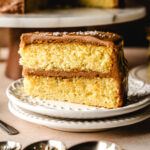
Cloud-soft Salted Caramel Cake (Southern Style)
With its cloud-soft yellow cake encased in a golden frosting with the taste and texture of fudge, this Salted Caramel Cake is the layer cake of your dreams.
Servings: 14
Calories: 612kcal
Ingredients
Cake
- 2 cups cake flour
- 1 ½ cups granulated sugar
- 1 ½ teaspoons baking powder
- ½ teaspoons baking soda
- 1 ½ teaspoons salt
- ¾ cup (1 ½ sticks ) unsalted butter room temperature, cut into 1-inch pieces
- 1 cup buttermilk
- 1 teaspoon vanilla extract
- 3 large eggs room temperature
Frosting
- 1 cup (2 sticks) unsalted butter room temperature, cut into 12 pieces, divided
- 2 cups dark brown sugar packed
- ⅔ cup heavy cream
- 1 teaspoon vanilla extract
- 2 cups powdered sugar
- 1 ½ teaspoons salt
- 2 teaspoons distilled white vinegar
- flaky salt
Instructions
- Preheat the oven to 325°F with a rack in the middle of the oven.
- Line two 8-inch round cake pans with parchment paper. Begin by spraying the bottom of the cake pans with nonstick spray. Then place parchment paper on top, pressing to adhere to the nonstick spray.If you do not have a piece of round parchment paper, here are instructions for how to line a round cake pan with parchment paper. You can trace the bottom of the cake pan with a pen or marker onto the parchment and cut that out. However, this produces a lot of waste and the ink on the parchment will now be touching your cake.Take a sheet of parchment paper and fold it into a square by folding one corner to the opposite side, aligning the corner to where it meets the opposite edge so you have a big triangle. Cut the excess from the bottom and reserve for another use.Fold one corner of the triangle towards the opposite corner to make a smaller triangle. Repeat one more time so you have a smaller triangle.Take the point of the triangle where all the folds are and hold in the middle of the overturned round pan. While holding that in place with your finger, trim the bottom of the triangle following the edge of the pan. Reserve the scraps to help spread butter on pans in other baking recipes.Unfold the triangle and place into the bottom of the sprayed pan. Set aside the prepared pan.
- Prepare the cake: In the bowl of a stand mixer with the paddle attachment affixed, mix together the cake flour, granulated sugar, baking powder, baking soda, and salt on low speed until combined, about 1 minute.2 cups cake flour, 1 ½ cups granulated sugar, 1 ½ teaspoons baking powder, ½ teaspoons baking soda, 1 ½ teaspoons salt
- Add the butter to the dry ingredients, increasing the mixer speed to medium-low, and beat until the mixture resembles wet sand, about 1 minute.¾ cup (1 ½ sticks ) unsalted butter
- Add the buttermilk and vanilla extract, beating until the batter is pale and fluffy, about 2 minutes (this extended mix time builds structure and prevents the cake from sinking; don’t worry about overmixing).1 cup buttermilk, 1 teaspoon vanilla extract
- One at a time, add the eggs, beating 30 seconds after each addition and scraping down the sides and bottom of the bowl with a rubber spatula as needed. The cake batter should be smooth and creamy.3 large eggs
- Scrape the batter into the prepared pans, dividing equally (about 550 g per pan). Bang the pans gently on the counter to remove any air bubbles from the batter and smooth the surface with an offset spatula.
- Bake the cakes in the preheated oven until golden brown and the tops of the cake spring back when gently pressed (an instant-read thermometer inserted into the center should register 205°), about 30–35 minutes. (Cakes may shrink slightly from the edges of the pan.)
- Transfer the cake pans to a wire rack and let cakes cool in pans while you prepare the frosting.
- Prepare the frosting: To a large saucepan set over medium heat, add ½ cup butter (1 stick; 8 tablespoons) and allow to melt.1 cup (2 sticks) unsalted butter
- Add brown sugar and whisk together until small bubbles appear around the perimeter of the pan and the mixture is smooth, 4 to 8 minutes, stirring continuously.2 cups dark brown sugar
- Whisk in the heavy cream and cook until a ring of bubbles reappears, about 1 minute. Turn off the heat and whisk in the vanilla extract.⅔ cup heavy cream, 1 teaspoon vanilla extract
- Transfer the hot frosting mixture to the clean bowl of a stand mixer. On low speed, gradually mix in the powdered sugar until incorporated. Add salt and increase the speed to medium and beat until the frosting is pale brown and just warm, about 5 minutes.2 cups powdered sugar, 1 ½ teaspoons salt
- Add the remaining 1 stick of butter, 1 piece at a time, and beat until light and fluffy, about 2 minutes.1 cup (2 sticks) unsalted butter
- Add the white vinegar and beat to incorporate. Tip: Use frosting while it is still slightly warm or it may become too firm to work with.2 teaspoons distilled white vinegar
- Assemble the cake: Turn 1 cake layer out from the pan, removing the parchment paper. Place cake layer, right side up, on a cake stand or large plate (use a cake turntable if you’ve got one; it will make frosting easier). Scoop 1 cup frosting (eyeballing is fine) on top and spread evenly with an offset spatula, pushing almost to the edges.
- Place the second cake layer, upside down, on top of frosted cake layer and remove the parchment paper. Working quickly, spread sides and top of cake evenly with the remaining frosting.
- Let the cake sit at room temperature at least 15 minutes to allow frosting to firm up slightly. Lightly sprinkle with flaky salt before serving.flaky salt
Notes
- Make Ahead: If preparing the cakes ahead of time, wrap them tightly in plastic wrap and store at room temperature up to 2 days. If preparing more than 2 days ahead of time, double wrap the cake layers individually with plastic wrap and freeze. Thaw at room temperature before making the frosting and assembling. I would not recommend preparing the frosting in advance, as it should be warm when spreading on the cake. It will firm up at room temperature or in the fridge and trying to warm it up in the microwave will result in greasy frosting.
- Cake can be assembled 12 hours ahead. Cover with a cake dome or an inverted bowl and store at a cool room temperature.
- Adapted from Bon Appétit and Cooks Illustrated.
Nutrition
Serving: 1 slice | Calories: 612kcal | Carbohydrates: 84g | Protein: 5g | Fat: 30g | Saturated Fat: 19g | Polyunsaturated Fat: 1g | Monounsaturated Fat: 8g | Trans Fat: 1g | Cholesterol: 118mg | Sodium: 632mg | Potassium: 117mg | Fiber: 0.4g | Sugar: 70g | Vitamin A: 992IU | Vitamin C: 0.1mg | Calcium: 95mg | Iron: 1mg
